

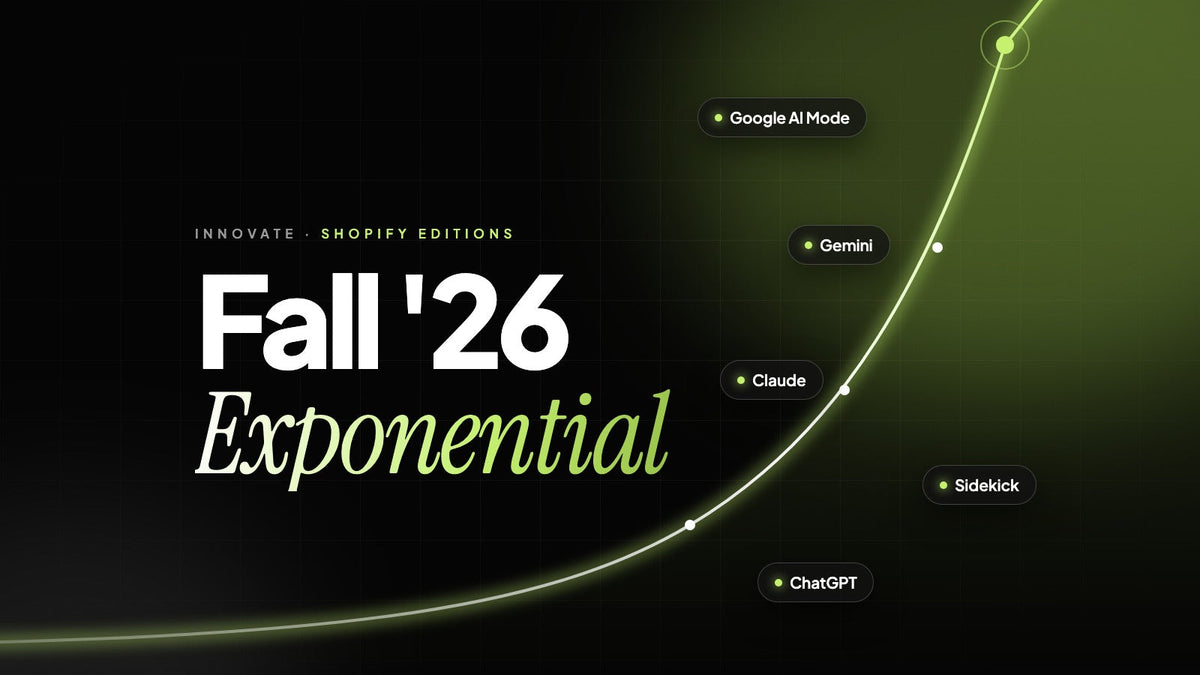
Shopify is no longer shipping a list of features. It's shipping a store that gets designed, run and sold with AI.
On October 28, Shopify released Shopify Editions Fall 2026, the update the platform launches a couple of times a year. This one is called "Exponential", and it comes with a very long list of new features, from checkout all the way to in-store point of sale.
As a Shopify Plus Partner, we read through all of it with one question in mind: what adds the most to a store that already sells. The thread running through everything is AI, now at the center of Shopify for selling, designing the store and running it. These are the updates we picked.
Shopping moves inside the conversation
The edition's biggest bet is putting your catalog where people ask what to buy. Shopify now lets brands sell from ChatGPT, Claude and other assistants, from Google Search (including AI Mode and the Gemini app), and track ChatGPT Ads sales right in the admin, according to the official Editions page.
There's a big network behind it: more than 400 million people already use Shop Pay, Shopify's one-tap checkout, and its connectors work with nine different assistants, according to Shopify's announcement. We covered the same shift in our piece on ChatGPT Ads: stores are starting to sell in places where there's no store.
One detail says a lot. The edition adds a check that tells you whether your catalog qualifies to show up in those assistants, and what's missing. An assistant doesn't fall for your banner: it reads your data. Titles, variants, prices, stock and policies become the shop window.

Sidekick and Canvas: AI proposes, you decide
Sidekick, the AI assistant inside the Shopify admin, is no longer just a help chat. It now builds plans with several changes at once, writes code, searches the web and, before suggesting anything, tests it with simulated shoppers to see if it works. Daily usage grew 4.2 times in a year (Shopify Editions).
Canvas, the new way to edit the whole store in a single view, lets you design by talking to Sidekick. Shopify says stores built with Canvas launch 20% faster.
It's a real jump in speed. But going faster isn't the same as going in the right direction. AI speeds up decisions; knowing what sells is still your brand's call. What to show first, how to tell a product's story, which friction to remove from checkout: none of that comes out of a prompt.

More tools to convert
Among all the AI, there are less flashy updates that move the needle for a store that already sells:
- Scheduled launches and A/B tests that bundle design, checkout, catalog and discounts into a single change, and roll back on their own when the promo ends. For Black Friday, CyberMonday or Hot Sale, that's less risk on the night that sells the most.
- Better predictive search: Shopify measured 8% more add-to-carts from the search bar.
- A shorter, more flexible checkout, with custom fields and a form that needs less scrolling (rolling out over the coming months).
- WhatsApp at checkout: ask shoppers for permission to message them and recover abandoned carts there, through an app. Where conversations with customers already happen on WhatsApp, this counts double.
Selling in more countries, with less friction
For brands that sell abroad, the edition adds a lot. Seven new local payment methods arrive, like Alipay, WeChat Pay, OXXO and MB WAY. And Managed Markets shows all-in international prices with duties and taxes included: according to Shopify, brands using it lifted international conversion by 50% (Shopify Editions).
The idea behind it is simple: buying from another country should feel like buying at home. It's something we see often. For Alelí, which sells to knitters all over the world, we built a custom Shopify checkout where every customer pays in her own currency, with Mercado Pago, PayPal or dLocal Go depending on where she's buying from.
When customers pay the way they're used to, borders stop getting in the way. And Shopify keeps adding tools to make that happen in more markets.

Questions your brand should be asking
- Is my catalog ready to be read by AI? If your product data is messy, assistants won't recommend you.
- Am I using AI to move faster, or to decide for me? The first one adds up; the second one doesn't.
- Is my store ready to sell in more countries? Prices, payment methods and shipping that feel local in every market.
- Am I heading into big sales dates testing changes, or guessing? A/B tests and scheduled launches exist so you don't bet everything on the day of the event.
What's next
The edition's name is a thesis in itself: exponential. Stores with tidy data and a clear point of view will get the most out of every update. The rest will keep adding tools without anything really changing. Just like with Tiendanube heading into 2027, the direction is the same: sell in more places, with less friction.
Want to make the most of what's new in Shopify for your store? Let's talk.


